Kennet House
I grew up in Kennet House, Cheetham Hill. Council flats. Concrete courtyards. The sound of kids playing between parked Cortinas. Hundreds of families stacked on top of each other in a tower block that the council built because Manchester needed somewhere to put people after the slums were cleared.
Later, we moved to Sonning Walk, still in Cheetham Hill, still close enough to walk into town in twenty minutes. And we did walk into town. All the time. Down Cheetham Hill Road, past the shops, past the synagogues and the wholesalers, through Strangeways, and you were in the middle of Manchester. Twenty minutes. No bus needed.
Kennet House is gone now. Demolished. The photo at the top of this page is from 1972. If you go to Cheetham Hill today, you won't find it. But the people who grew up there haven't forgotten. You never forget the place that made you.
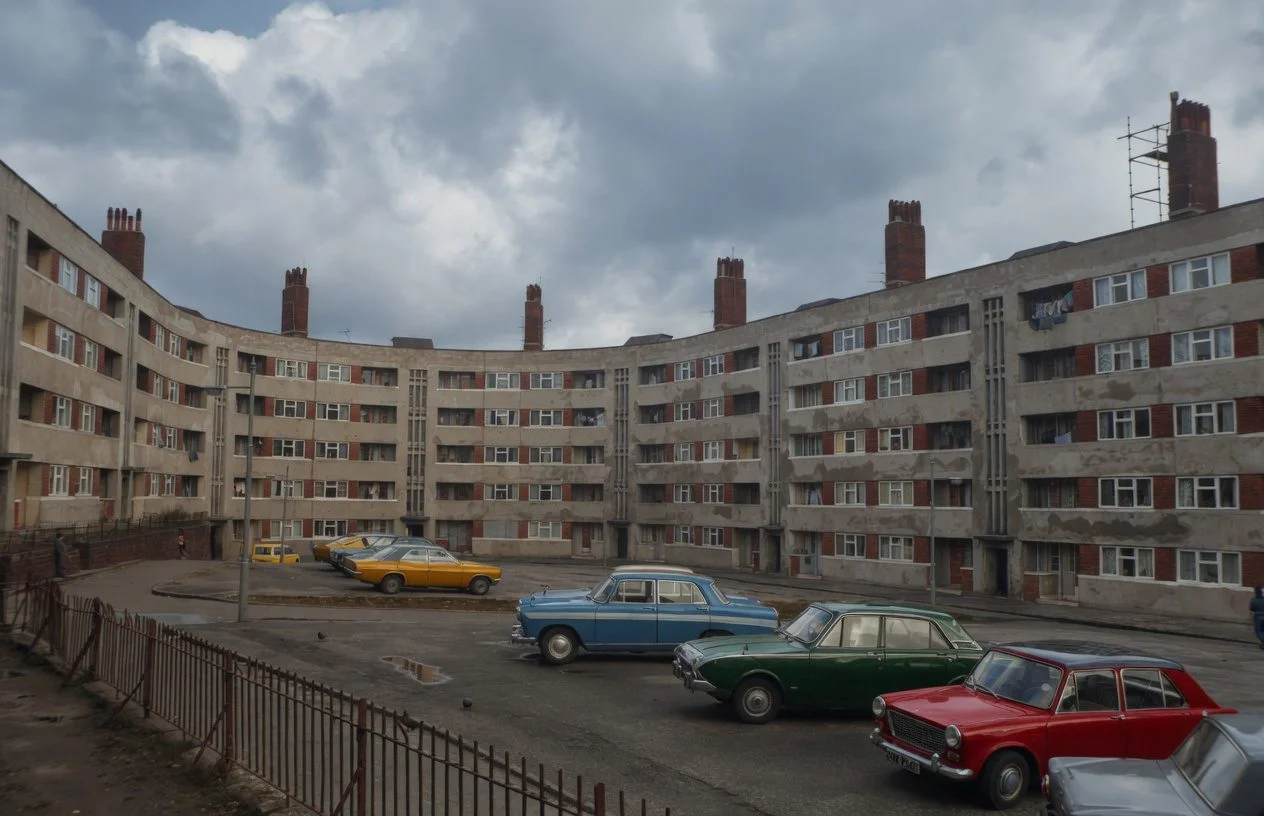
Kennet House, Cheetham Hill, 1972. Council flats, concrete courtyards, and home to hundreds of Manchester families. Demolished. Gone. But not forgotten.
St Chad's
I went to St Chad's Roman Catholic Primary School in Cheetham Hill, and I had my First Holy Communion at St Chad's Church. I didn't know it at the time, but St Chad's is the Catholic mother church of Manchester. The first post-Reformation Catholic church in the city, tracing its origins back to a chapel on Rook Street in 1776.
The building I knew was designed by Weightman and Hadfield, built between 1846 and 1847. Hadfield. The same architect who built The Hidden Gem on Mulberry Street. I didn't know that either. You don't think about architects when you're seven years old and trying not to fidget during mass.
St Chad's is now the Manchester Oratory, run by the same Oratorian community that came from the Church of the Holy Name of Jesus on Oxford Road. The Holy Name. The church that Morrissey wrote about in Vicar in a Tutu. The church where we held the funeral mass for my grandmother.
Two churches, decades apart, connected by the same religious order. Two moments in my life tied together by a thread I couldn't have known about as a child kneeling at the altar rail for my First Communion.
"You don't think about architects when you're seven years old and trying not to fidget during mass."
The Pictures
We called it "the pictures." Not the cinema. The pictures. And the pictures meant the Temple Picture House on Cheetham Hill Road.
The Temple opened in 1913 as the Temple Pictorium. It held 1,250 people, which tells you something about how important the pictures were back then. No television. No streaming. If you wanted to see a story, you went to the Temple.
I saw Spider-Man there in 1977. The Amazing Spider-Man with Nicholas Hammond. Marvel had me first. Then Star Wars in early 1978 - it opened in London on the 27th of December 1977 and rolled out to cities like Manchester in late January. A kid from Kennet House sitting in the dark at the Temple Picture House, watching a farm boy from Tatooine blow up the Death Star.
I don't remember what I had for tea that night. I don't remember what the weather was like. I remember every second of that film.
Then, later that same year, Superman. Christopher Reeve in the red cape. December 1978. The same seat, the same picture house, a different universe. Spider-Man, Star Wars, Superman - three films, two years, one picture house in Cheetham Hill. Spider-Man got there first, but it was Christopher Reeve who changed everything. From that day forward I've been a DC Comics fan. Superman, Batman, Wonder Woman, Green Lantern. Marvel had the first shot and lost me to a man in a cape. It all started at the Temple.
The Temple is gone now. Demolished. The Fort Shopping Park sits where it used to be. A retail park with a Currys and a Sports Direct where 1,250 people once sat in the dark and watched the pictures. Another Manchester building that exists only in the memories of the people who were there.
But the Temple wasn't the only picture house. Sometimes, on Monday nights, we'd go to the Odeon on Oxford Street. The Odeon opened in 1930 as the Paramount Theatre, a proper art deco palace. On Mondays they showed Chinese films. My dad was from Hong Kong, and this was the only time of the week he could see a movie from home. We didn't go often. I only remember going two or three times. But I remember the subtitled kung fu movies, the pretty Chinese girls, and the guys with the long hair and equally long eyebrows.
For my dad and the other Hong Kong families in Manchester, Monday nights at the Odeon were something. A room full of people watching a film in Cantonese in the middle of Manchester. That's not in any history book. That's not on any heritage plaque. But it happened, every Monday, and it mattered.
The Odeon closed its doors in 2004 after 74 years. The building sat empty and derelict for over a decade before they finally demolished it in 2017. Another gorgeous building left to rot and then knocked down. Manchester has a habit of that.
Trafford General Hospital
My mother, Genevieve, was born in Trafford General Hospital. She died there too, in 1989, from cancer. The same building. The beginning and the end, in the same place.
Trafford General is where the National Health Service was born. On the 5th of July 1948, Aneurin Bevan launched the NHS there, and the first patient was treated under the new system that morning. The hospital that gave the country free healthcare at the point of need is the same hospital where my mum took her first breath and her last.
Some buildings are just buildings. Some carry the weight of everything.
Moss Side
My Aunty Cath lived in Moss Side. We'd go over to visit and I'd run around outside in the garden. That's where I caught my forehead on a thorn from a rose bush and bled everywhere. I've still got the scar. Every family has a story like that. A tiny moment that brands itself into your memory because of the shock of it, the blood, the fuss.
Moss Side gets a reputation. It always has. But Moss Side is also where Emmeline Pankhurst was born. The woman who changed the course of British democracy came from the same streets. Moss Side gave the world the suffragette movement, and it doesn't get enough credit for that.
Urmston
My grandmother Henrietta lived in Urmston. We used to visit quite often. She had a very old grey poodle called Binky. Binky was blind, had no teeth, and could barely stand. I think Binky continued long past his best before date. But he was her dog, and she was his person, and that was that.
Her funeral mass was held at the Church of the Holy Name of Jesus on Oxford Road. The same church I mentioned earlier. The one Morrissey wrote about in Vicar in a Tutu. The one connected to St Chad's through the Oratorian community. Two moments in my life, decades apart, in two churches run by the same order.
But what I remember most about that day isn't the service. It's that the hearse received a parking ticket. A parking ticket. On the hearse. Outside a church. During a funeral. Only in Manchester.
Watching the City Change
I remember the Arndale Centre being built. Watching it go up, this massive concrete thing swallowing the streets I knew. It had a bus station underneath it. A proper underground bus station where you'd wait for your bus in the fumes and the noise. That bus station is gone now. The space where it stood is Exchange Square, with a big screen and a Christmas wheel and a tramline running through it.
I remember walking from Cheetham Hill to the Printworks, to Victoria Station, through streets that don't look anything like they did when I was a kid. The city kept changing. The skyline kept growing. The old Manchester was being knocked down and the new Manchester was being built on top of it, sometimes literally.
That's what this site is about. Not just the famous legends and the grand buildings and the dates from history books. It's about the Manchester that ordinary people remember. The council flats and the picture houses and the rose bushes and the churches where you had your First Communion. The city that made you who you are, even after it demolished the buildings you grew up in.
Manchester doesn't forget where it came from. It just refuses to stay there.