Photography
Salford Quays, April 2026
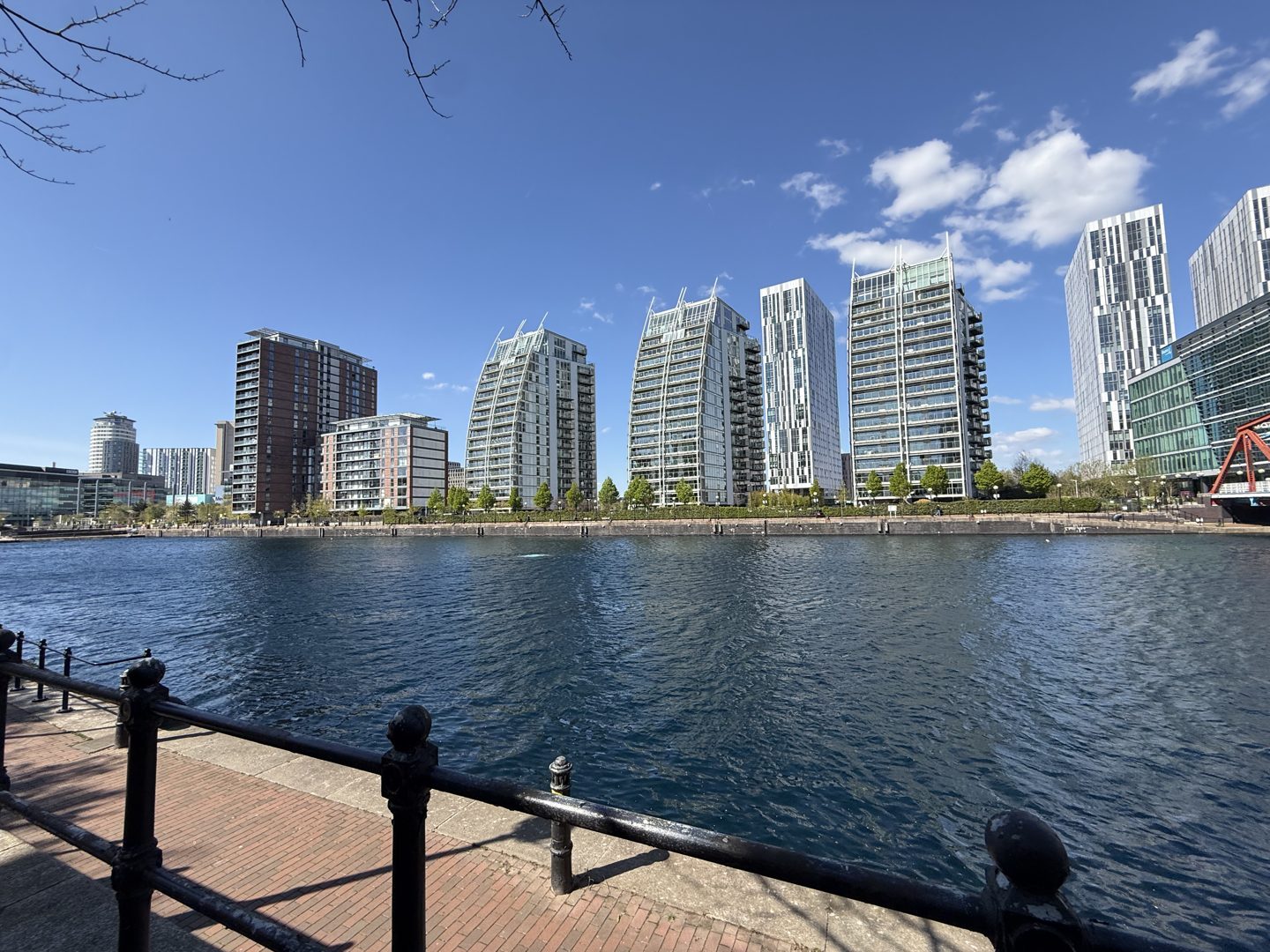
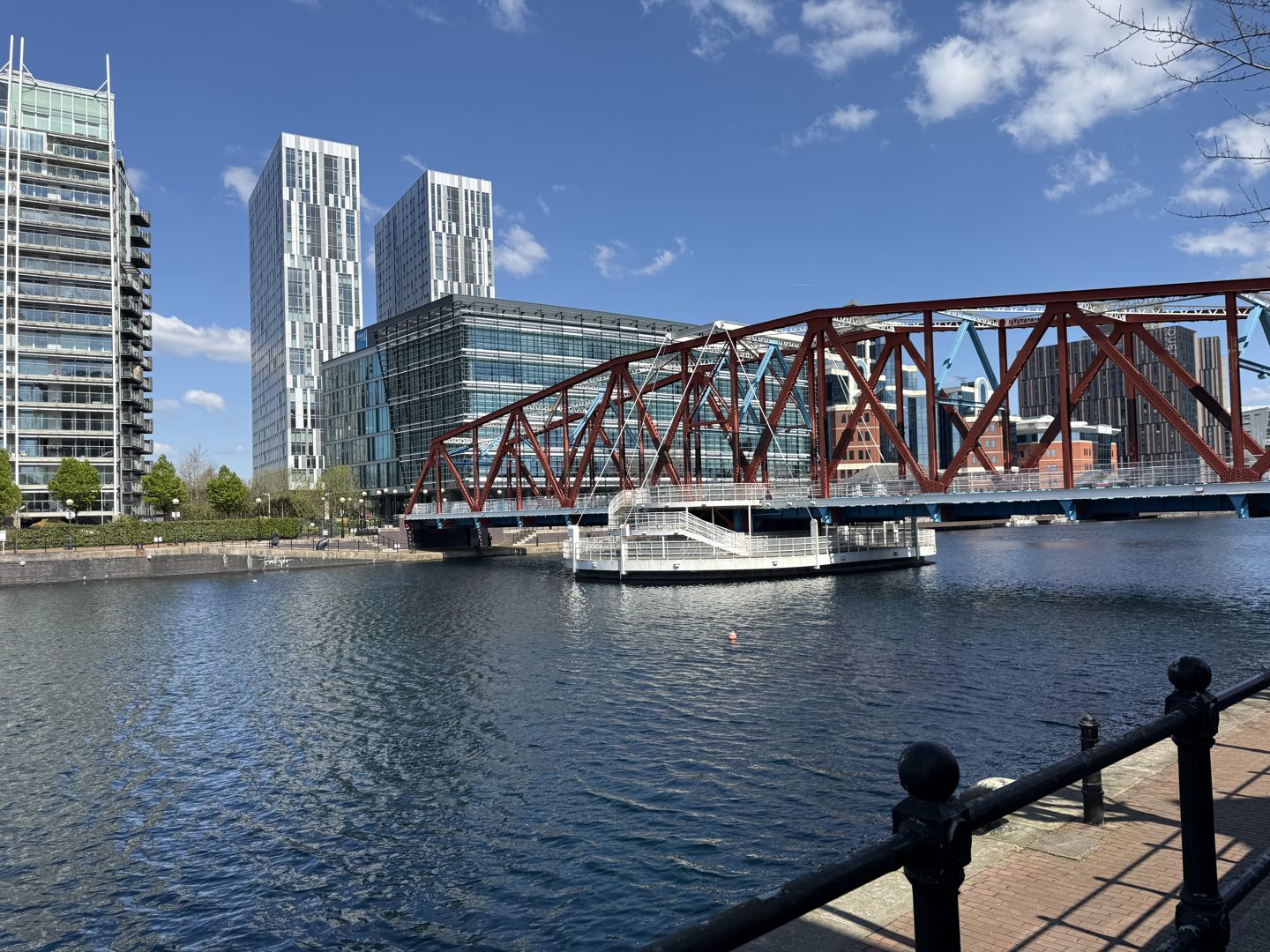
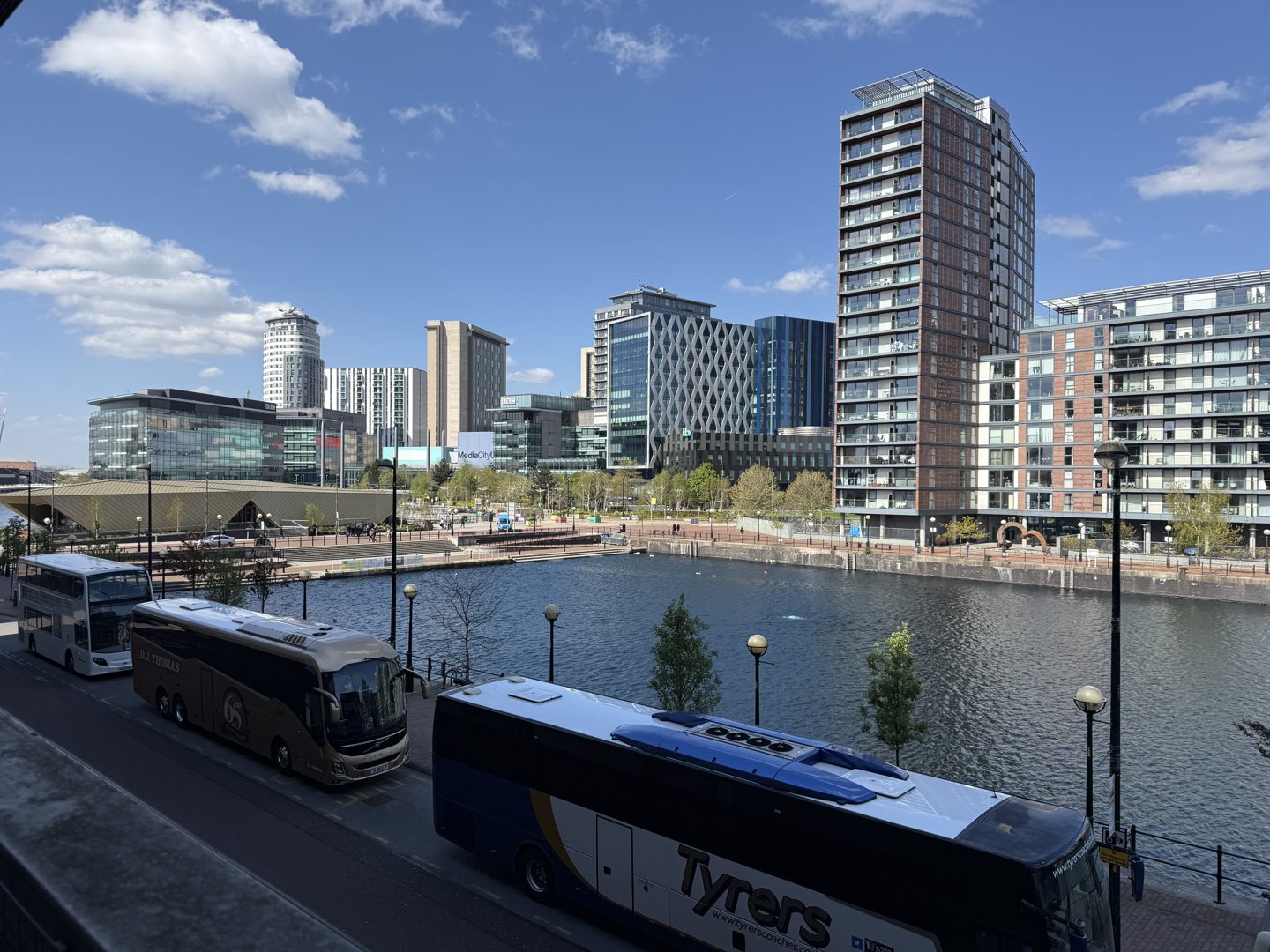
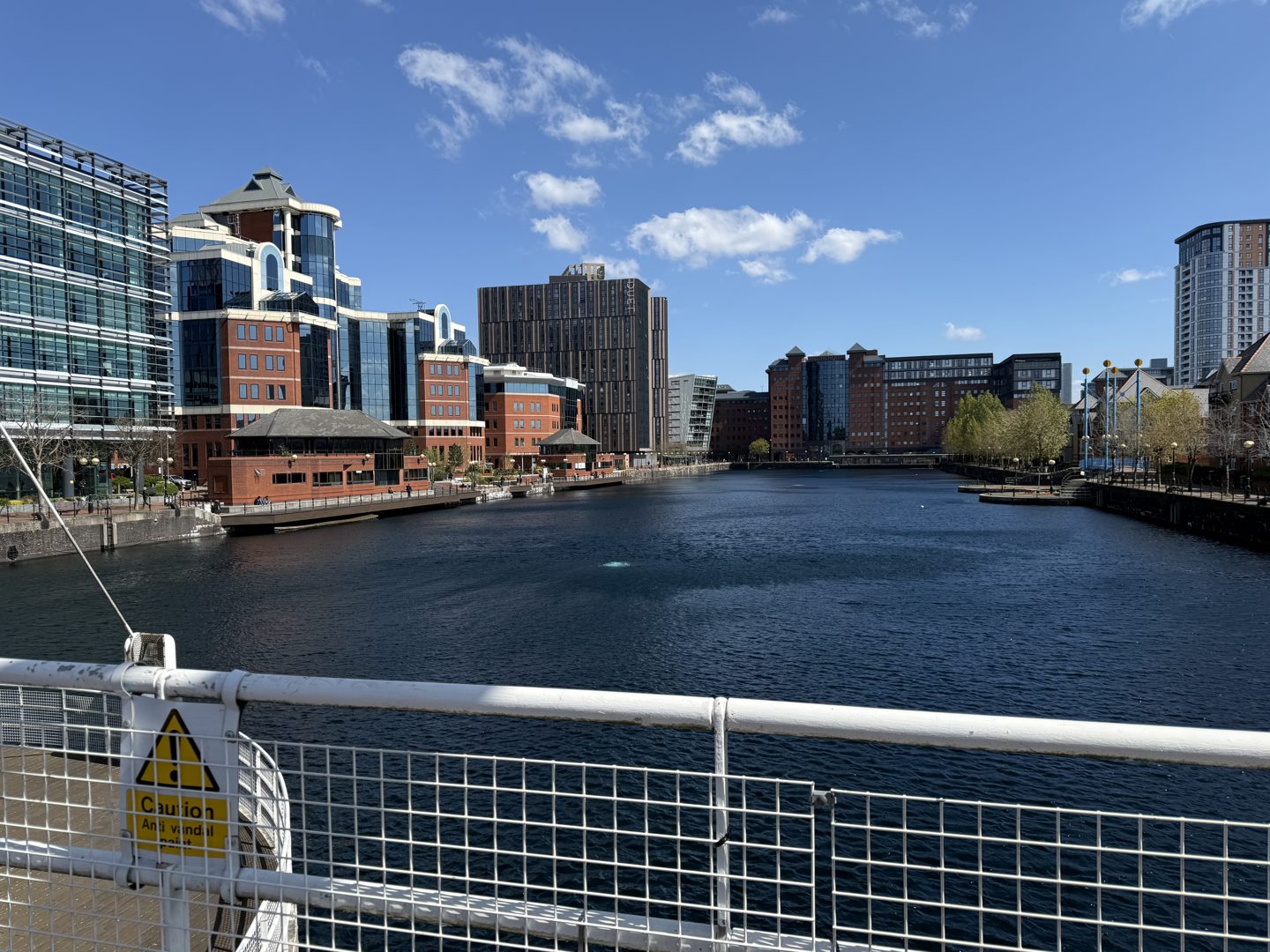
Where the docks met the future. Original photography by Laurence Lai.
"Manchester's other half. Always has been."
Salford sits right across the Irwell from Manchester city centre. You can walk from Deansgate to Salford in two minutes without realising you've crossed a border. But Salford is its own city, with its own stories, its own accent, and a chip on its shoulder the size of the Lowry.
Most people think Salford is part of Manchester. It isn't. Salford got its Royal Charter 71 years before Manchester did. It's been a city in its own right since 1926. The River Irwell is the border, and if you ask anyone from Salford, they'll make sure you know which side they're from.
Salford has a habit of being first. In 1843, a Salford activist called Robert Lowes fought for workers' right to Saturday afternoons off, reshaping the modern weekend. In the early 1800s, Reverend William Cowherd urged his Salford congregation to adopt a meat-free diet, and members of his church went on to become leaders of the Vegetarian Society and published the first-ever vegetable diet cookery book. The modern weekend and the vegetarian movement both have roots in Salford.
For centuries, Salford was working docks, cotton mills, and terraced streets. During the 18th and 19th centuries it was an engine of global cotton manufacturing and heavy engineering. The Bridgewater Canal, which terminates here, was the first true canal in England and kickstarted the industrial revolution. In 1850, Salford established the United Kingdom's first unconditionally free public library. Peel Park, one of England's first public parks, was funded entirely by public subscription. This was a city that built things for its people before anyone else thought to.
Engels lived here in the 1840s and wrote about the conditions of the working class. Lowry painted these streets for 40 years. The docks closed in 1982 and the whole place could have died. Instead, they built MediaCityUK on the old quays, moved the BBC up from London, and turned it into one of the biggest media hubs in Europe.
That transformation is the most Salford thing imaginable. Get knocked down, get back up, build something bigger.
The River Irwell is the border between Manchester and Salford. It's been crossed, bridged, argued over and fallen into for nearly a thousand years. Most people walk across one of the bridges every day without looking down, let alone wondering who built it or why. But every bridge on that river has a story.
Blackfriars Street / Chapel Street
Look over the parapet of Blackfriars Bridge today and you'll see apartment blocks and smart hotels linked by a riverside walkway. In Victorian times, this was one of the most deprived stretches in the city. The Frenchman Alexis de Tocqueville visited in 1835 and described the marshy land at river level, with its muddy ditches and one-storey houses, as "the last refuge a man might find between poverty and death." His famous line about Manchester came from here: "From this foul drain the greatest stream of human industry flows out to fertilise the whole world. From this filthy sewer pure gold flows." Official reports described a cellar dwelling housing 18 people, two or three to a bed, and a narrow passage off Deansgate with one privy serving 380 inhabitants. The current stone bridge was completed in 1820, designed by Thomas Wright of Salford. But the original wooden bridge on this spot, built in 1761, was built by a company of comedians who performed in a theatre on the Salford side and needed their Manchester audience to get across the river.
This stretch of the Irwell near Blackfriars is where Mark Addy, a Salford publican and champion oarsman, pulled over 50 people out of the heavily polluted river during the 19th century. Queen Victoria awarded him the Albert Medal First Class for it. A pub on the Salford bank was named after him, though it closed in 2013. The riverside that Tocqueville described as the last refuge between poverty and death is now some of the most expensive real estate in Salford. The physical evidence of that misery disappeared long ago. But 40,000 bodies are still buried under Angel Meadow, just across the water.
Irwell Street / New Bailey Street
Grade II listed, built around 1880, and the one to look at properly. The cast iron piers carry the Salford coat of arms: five bees representing the five industrial communities that formed the borough, a gold shuttle for the textile trade, and two black millrinds for engineering. The blue and gold background comes from the Earls of Chester, who granted Salford its first charter in 1230. Nearly 800 years of history, cast in iron on a bridge most people cross without a downward glance.
Look at the lattice-work cross bracing underneath the bridge. Every rivet has a decorative rosette over it. Someone in 1880 decided that even the underside of a bridge in Salford deserved to be beautiful. That's Victorian civic pride for you.
Victoria Street / Chapel Street
Completed in 1839, named after the Queen, and built to replace the medieval Salford Old Bridge that had stood on this crossing since the 14th century. For 500 years, this was the main route between Manchester and Salford. Every cart, every worker, every trader crossed here. The current bridge is the one you walk over from the Cathedral towards Salford Central station.
Chapel Street / Cathedral Gardens
The modern one. Designed by Santiago Calatrava, the Spanish architect, and completed in 1995. A three-way footbridge that splits in three directions as it crosses the Irwell. It looks like nothing else on the river and it's a reminder that Manchester and Salford are still building bridges between each other, literally and figuratively.
Salford's got more hidden stories per square mile than most cities have in total. Here are the ones even locals don't always know about.
Taylorson Street, Ordsall
A Tudor manor house sitting in the middle of a Salford housing estate. It first appeared in records in 1177 as "Ordeshala" and the Radclyffe family took ownership around 1335, holding it for over 300 years. Sir John Radclyffe campaigned with Edward III in France during the 1340s, and as a reward the King let him bring Flemish weavers back to Ordsall. He built cottages for them on the estate and they taught the locals silk weaving. That decision, made in a manor house in Salford in the 14th century, laid the foundation for Manchester's entire textile industry. The Great Hall has one of the finest hammerbeam roofs in the north. During Elizabeth I's reign, striking twins Alexander and Margaret Radclyffe were a sensation at court. Margaret was the Queen's lady-in-waiting and reportedly died of a broken heart three months after her brother was killed in Ireland in 1599.
Guy Fawkes is said to have plotted the Gunpowder Plot here. There's no firm proof, but the Radclyffes were prominent Catholics and knew the Catesby family, so the local legend is plausible enough that William Harrison Ainsworth set his 1841 novel "Guy Fawkes" in the hall. The family's Royalist loyalties during the Civil War ruined them financially, and in 1662 they were forced to sell. After that it passed through various hands, serving as a clergy school, a working men's club, and even a radio station. Pre-Raphaelite painter Frederic Shields lived here for a time. Salford Council bought it in 1959 and opened it to the public in 1972. Free entry. 850 years of history in the middle of a housing estate, and most people in Salford have never been inside.
The Radclyffe family owned it for over 300 years. The ghost of a White Lady is said to haunt the Star Chamber. Whether you believe that or not, walking through a medieval hall surrounded by 1960s council flats is an experience you won't forget.
Pier 8, Salford Quays
A theatre and gallery complex that opened in 2000, named after L.S. Lowry, and built on the docks he spent 40 years painting. It houses the world's largest public collection of Lowry's work, over 400 pieces, alongside two theatres seating 1,730 and 466. The building was designed by Michael Wilford, and from the outside it looks like a piece of folded steel and glass dropped onto the waterfront. Step outside the main entrance and you can see Old Trafford, Manchester United's ground, just across the Ship Canal. Walk over the Millennium footbridge and down Wharfside Way and you're there in ten minutes. Lowry paintings, the BBC, and the Theatre of Dreams, all within walking distance of each other.
The gallery is free. You can walk in off the street and stand in front of the largest collection of Lowry paintings anywhere in the world without paying a penny. The man who spent his life painting the working people of Salford would probably have appreciated that. The theatres host everything from stand-up comedy to opera, making it one of the most versatile arts venues outside London.
St Ignatius Walk, Ordsall
A red brick Edwardian youth club that became a place of pilgrimage thanks to The Smiths. The photograph on the inside gatefold of The Queen Is Dead was taken outside this building in 1985, and appeared on the album when it was released in 1986. Fans still come from all over the world to stand on that exact spot.
The club has been running since 1903 and is still open, still working with young people. It's not a museum or a Smiths gift shop. It's a functioning youth club with a boxing ring and a pool table, and it's been changing lives in Ordsall for over 120 years. The Smiths connection is a bonus, not the point.
Jubilee House, The Crescent
A library dedicated entirely to the history of working people. Trade union banners, Chartist documents, suffragette pamphlets, strike records, and 200 years of ordinary people fighting for better lives. There is nowhere else like it in the country.
It was founded by Ruth and Eddie Frow, who spent decades collecting books, pamphlets, and documents from their home in Old Trafford. The collection grew so large they donated it to the people of Salford. It's free to visit and barely anyone knows it's there.
Worsley Village
The canal that started the industrial revolution. Literally. Francis Egerton, 3rd Duke of Bridgewater, commissioned it in 1759 to carry coal from his mines at Worsley to Castlefield in Manchester. It halved the price of coal overnight and changed the course of British industry. The Delph itself is the entrance point, a centuries-old sandstone quarry where twin archways lead into the underground mine system. Originally there was one entrance. As the mine's output grew, a second was added so boats could go in one way and come out the other. The water at the basin is bright orange, stained by iron ore leaching out of the rock. It's been that colour for 250 years.
Behind those twin archways, 47 miles of underground canals were carved out on four different levels, connected by a water-powered inclined plane and lifts that moved boats between them. Boats went into the mine, were loaded with coal underground, and came back out into daylight at the Delph. Most of those tunnels are still down there, flooded and inaccessible. In 2004 a water treatment plant was built to reduce the iron deposits before the orange water reaches the main canal. Stand at the basin on a quiet morning, look at the twin archways, and try to imagine 47 miles of canal disappearing into the rock beneath your feet. The entire industrial revolution started in this hole in the ground.
Barton upon Irwell
The only swing aqueduct in the world. When the Manchester Ship Canal was built in the 1890s, it cut straight through the path of the Bridgewater Canal. The original stone aqueduct, built by James Brindley in 1761 and considered one of the seven wonders of the canal age, was too low for ships to pass underneath. So engineer Edward Leader Williams designed something that had never been built before. An iron trough, 234 feet long, that carries the Bridgewater Canal over the Ship Canal. When a large vessel needs to pass, gates seal the water inside the trough and the entire structure swings 90 degrees on a central pivot, holding 800 tonnes of water as it turns. It was completed in 1893 and it's Grade II* listed.
The full weight of the aqueduct when loaded with water is around 1,450 tonnes, roughly the weight of 240 African elephants, rotating on a single pivot. The River Irwell had to be temporarily diverted so the central island could be built on dry land. The original aqueduct it replaced was so audacious for its time that people refused to believe a canal could be carried over a river. The Duke of Bridgewater reportedly called it a "castle in the air." The swing aqueduct is still operational. No one has ever built another one.
Chapel Street, Salford
A Victorian church on Chapel Street, designed by Sir Robert Smirke in the 1820s. Grade II* listed, with fine stained glass and a quiet interior that feels a world away from the traffic outside. Most people who visit The Lowry gallery at the Quays have no idea it exists, ten minutes away on Chapel Street.
Worsley New Road, Worsley
154 acres of horticultural brilliance, managed by the Royal Horticultural Society. Their fifth garden and the biggest gardening project in Europe. Built on the site of the former Worsley New Hall estate, it opened in 2021. The estate was abandoned 70 years ago, but traces of the original gardens remained, including a magnificent walled garden and lake. The RHS chose to create "a new painting in the historic frame," combining restoration with new landscapes designed by Tom Stuart-Smith.
At the heart of it is the Chinese Streamside Garden, seven acres designed by Chinese landscape expert Fan Xuquan, inspired by the Ye Garden in his city of Yangzhou. A collaboration between Salford's Chinese community and horticultural experts in China. Rocks arranged as miniature mountain peaks, a meandering stream connecting the upper Ellesmere Lake with Moon Bridge Water, a new lake named from an ancient Chinese poem. Five wooden bridges cross the stream through woodland, a bamboo garden, and a Chinese meadow. Magnolias, rhododendrons, Ginkgo Biloba, and the handkerchief tree Davidia Involucrata, all plants that originated in China and transformed British gardens. The walled garden alone is 11 acres. The estate was originally owned by the Bridgewater family, the same family that built the canal that started the industrial revolution. From coal mines to Chinese gardens. Salford keeps reinventing itself.
Eccles
The Eccles cake, that buttery, flaky, currant-filled pastry, was first sold commercially in Eccles in 1793 by James Birch from his shop on the corner of Church Street. It's been exported around the world since. There are fancier pastries, but none with a better origin story: a bloke in a shop in Eccles, and the whole world wanted one.
Peel Park Campus, University of Salford
A five-metre fibreglass sculpture of Friedrich Engels's head, dominated by his enormous beard, which doubles as a bouldering wall. Stairs at the back, climbing holds up the front, viewing platform on top. Created by artist Jai Redman and unveiled in September 2016, commissioned as public art for the University's New Adelphi building. It was inspired by a failed 1980s plan to bring an actual Engels statue from an Eastern Bloc country to Manchester. That plan fell through. Thirty years later, someone built a climbable beard instead.
Redman's artist statement says it's "not a monument but a metaphor for the effort and struggle needed to pull ourselves out of ignorance, and a direct representation of how we all stand on the shoulder of giants." A year after this was unveiled, a real Soviet-era Engels statue arrived in Manchester from Ukraine, sawn in half and reassembled outside HOME on Tony Wilson Place. Two separate projects, a year apart, both bringing Engels back to the city where he did his most important work. Neither team knew about the other. Manchester's relationship with Engels is apparently so strong it produces public art by coincidence.
Peel Park, The Crescent
Opened in 1850 as the first unconditionally free public library and museum in the country. Queen Victoria and Prince Albert were its royal patrons. But the real treasure is on the ground floor. Lark Hill Place is a full-size recreation of a Victorian street, complete with shopfronts, a pub, a cobbler, a chemist, and period-correct lighting. You walk through it and you're in Salford in the 1890s. The detail is extraordinary. The museum sits in Peel Park, where in 1842 thousands of striking workers gathered during the Plug Plot riots, and where Engels used to walk while writing about the conditions of the working class. Free entry, always has been. That was the whole point when it opened.
L.S. Lowry was a regular visitor and credited the museum's collection with influencing his early work. The gallery upstairs holds one of the largest collections of Lowry paintings outside The Lowry theatre at the Quays. Two Lowry collections, in the same borough, within a couple of miles of each other. Salford owns that man's legacy and always will.
Cemetery Road, Weaste
Opened in 1857, Salford's oldest cemetery covers 39 acres and holds over 332,000 graves. The first person buried here was Joseph Brotherton, Salford's first MP, who campaigned for the cemetery and died just before it opened. But it's the other names in here that make it extraordinary. Sir Charles Hallé, the German immigrant who founded the Hallé Orchestra. Eddie Colman, the Busby Babe who died at Munich aged 21. Mark Addy, who pulled over 50 people from the River Irwell over his lifetime and was awarded the Albert Medal. Ferdinand Stanley, who survived the Charge of the Light Brigade and was immortalised by Tennyson. And Prince Lobengula, a southern African prince who came to Salford with a travelling circus, married a local Irish woman called Kitty, and ended up in an unmarked public grave.
373 Commonwealth service personnel from both World Wars are buried here, maintained by the Commonwealth War Graves Commission. An MP, an orchestra founder, a Busby Babe, a Light Brigade survivor, a river rescuer, and an African prince who married an Irish woman from Salford. All in the same 39 acres. You couldn't make it up.
Across the bridge, Trafford Wharf Road
Technically in Trafford, not Salford, but you can see it from the Quays and walk to it in five minutes across the Millennium Bridge. Daniel Libeskind designed it as three interlocking shards representing a globe shattered by conflict. The Big Picture Show, projected onto the walls of the main exhibition space every hour, is unlike anything you've experienced in a museum. Free entry. Allow at least two hours. See our Trafford page for the full story.
Salford has produced more than its fair share of people who changed things. Some of them were born here. Some of them did their best work here. All of them belong to Salford.
Lived and painted in Pendlebury for nearly 40 years. His matchstick figures became the most recognised depiction of industrial northern England. Turned down five honours including a knighthood.
Born in Langworthy. The first Doctor to sound northern. Refused to soften his Salford accent for any role. Let Him Have It, Shallow Grave, Our Friends in the North.
Born in Salford. Wong in the Marvel Cinematic Universe. Also Kublai Khan in Marco Polo and brilliant in everything he touches. Representing Salford on the global stage.
Lived in Salford for over 20 years, managing a cotton mill by day and documenting the exploitation of workers by night. His book The Condition of the Working Class in England was based on what he saw here.
Grew up in Pendlebury. De La Salle College, University of Salford, trained with the Salford Players. Made his TV debut on Coronation Street before the RSC, Gandhi and an Oscar. The University of Salford named a 200-seat theatre after him in 1996. Still calls Salford his formative home.
Salford. Bassist and co-founder of Joy Division and New Order. That bassline on Blue Monday? Salford. That bassline on Love Will Tear Us Apart? Also Salford.
Born and raised in Salford, 1818. The physicist who established that heat is a form of energy. The unit of energy, the joule, is named after him. Every time anyone in the world measures energy, they're using a unit named after a man from Salford.
Born in Broughton, Salford, 1938. Wrote A Taste of Honey barely out of her teens. It became one of the most important plays of the 20th century. Morrissey put her face on a Smiths single sleeve. Salford's teenage playwright who changed British theatre.
Born in Salford, 1903. Wrote Love on the Dole in 1933, a novel about unemployment in a Lancashire town during the Depression. It was so politically powerful the British Board of Film Censors refused to certify the film adaptation in the 1930s, calling it "too sordid." It wasn't allowed to be filmed until 1940. Salford's own story, written by one of its own.
Born in Pendleton. Saturday Night and Sunday Morning, Tom Jones, Erin Brockovich, Skyfall. One of the greatest British actors of the 20th century. Lived and worked in London from the 1960s but never lost his Salford roots.
Born in Broughton, Salford. Folk singer, playwright, political activist. Wrote "Dirty Old Town" in 1949, and it wasn't about Dublin as everyone assumes. It was about Salford. The gasworks, the canal, the factory wall. Every word of it.
Salford's punk poet. "Evidently Chickentown", "Beasley Street", rapid-fire verse delivered in a Salford accent that could strip paint. Arctic Monkeys named a song after him. Still performing, still unmistakably Salford.
Shaun Ryder was born in Little Hulton, Salford, in 1962. Formed Happy Mondays in 1980 with his brother Paul and Bez. "Step On", "Kinky Afro", pills, thrills, and bellyaches. They helped define the Madchester scene and put Salford at the heart of a musical revolution. Manchester gets the credit. Salford produced the band.
Bolton-born, Salford-educated. Studied Media Performance at the University of Salford. Phoenix Nights, Car Share, and the biggest-selling stand-up tour in British comedy history. Greater Manchester to his bones.
Salford publican and champion oarsman who pulled over 50 people out of the polluted River Irwell near Blackfriars Bridge. Awarded the Albert Medal First Class by Queen Victoria. A pub on the Salford riverbank carried his name until it closed in 2013.
Studied at the University of Manchester. Best known as Jesus of Nazareth in Franco Zeffirelli's 1977 epic. Those blue eyes staring out of the television screen traumatised an entire generation of children on Easter Sunday.
The University of Salford started life in 1858 as the Salford Working Men's College. Think about that for a second. In 1858, working men in Salford decided they wanted to educate themselves, so they built their own college. That's the most Salford thing you'll ever hear.
It merged with the Pendleton Mechanics' Institute, became the Royal Technical Institute in 1896 (the Duke and Duchess of York opened it personally), grew into a College of Advanced Technology, and finally received its Royal Charter from the Queen in 1967. Prince Philip was its first Chancellor and stayed in the role for 24 years.
The alumni list reads like a casting call for a very good film. Sir Ben Kingsley trained here before his Oscar for Gandhi. Peter Kay studied Media Performance here before becoming the biggest stand-up in the country. Robert Powell studied at the University of Manchester before playing Jesus. Jason Manford came through here. Jim Sturgess. Even a former President of Tanzania.
For a university that started as a working men's self-improvement project in Victorian Salford, that's not a bad legacy.
The university named a 200-seat performing arts space after Sir Ben Kingsley in 1996. He came back to Salford to open it personally. Kingsley still refers to his time in Salford as formative, crediting the Salford Players amateur group and his time at De La Salle College with shaping his early career.
Where the docks met the future. Original photography by Laurence Lai.
If you've got a morning or an afternoon, here's how I'd spend it. Start at Ordsall Hall. It's free, it's stunning, and it takes about 45 minutes. Walk along the canal towpath towards the Quays. Stop at The Lowry gallery (also free). Cross the footbridge to MediaCityUK and have a coffee at one of the places along the waterfront.
If you've got more time, head to Salford Lads Club on the way to Ordsall Hall. It's a five-minute detour and the photo opportunity is irresistible, especially if The Smiths mean anything to you. Then loop back via Chapel Street to see the Working Class Movement Library and St Philip's Church.
If you're driving, Worsley Village is worth the trip for the canal basin alone. The orange water, the black and white Tudor buildings, and the Packet House pub. It's a different Salford entirely.
Tram: MediaCityUK and Salford Quays Metrolink stops for the Quays and Lowry. Langworthy for Chapel Street and Ordsall.
Walking: Salford is right across the river from Manchester city centre. You can walk from Deansgate to Ordsall Hall in 15 minutes.
Bus: Chapel Street buses from Manchester. The 33 and 34 run through to Swinton and Pendlebury.
Driving: Worsley Village is easier by car. Free parking at the canal basin. The Quays have paid parking but the tram is easier.
Spotted an error? Think I've missed something that should be here? Got a hidden story about Salford that deserves telling? This site is built by a local, but no one knows everything. If you've got something worth adding, I want to hear it.